
Recovery shouldn’t feel overwhelming — it should feel supported.
Personalized Care That Starts Before Surgery and Stays with You After
At Central Indiana Orthopedics (CIO), we believe the best outcomes begin with education, safety and support — and continue well beyond the day of surgery. Our outpatient hip and knee replacement patients aren’t sent home with a stack of instructions and left to figure it out alone. Instead, they’re supported every step of the way — from surgery to physical therapy and follow-up care, often all available under one roof at our locations.
That’s why every CIO outpatient hip and knee replacement patient has access to Natalie McClintick, NP, a dedicated Nurse Practitioner Patient Navigator who is available 24/7 after surgery. Natalie serves as a single, trusted point of contact for patients and their families—someone who has over 25 years of orthopedic experience, understands their concerns and is always just a phone call away.
“Even though CIO is growing, we continue to focus on personalized patient care,” Natalie said. “Our patients are not falling through the cracks — they feel secure and taken care of after surgery.”
Joint Replacement “Myth Vs. Fact” Instagram Post
View this post on Instagram
Why This Level of Support Matters
Before joining CIO, Natalie spent nearly two decades in orthopedics coordinating care and teaching joint replacement classes. She saw firsthand how overwhelming the discharge process can be. Patients receive a large amount of information while still recovering from anesthesia and pain medication — and even when instructions are repeated, questions and uncertainty often arise once they’re home.
Natalie helped design a better approach: continuous, proactive support that meets patients where they are, in real time.
“Nine o’clock at night, ten o’clock at night — patients are always surprised when a nurse practitioner answers,” Natalie shared. “Being there to answer a simple question brings peace of mind. It’s a blessing to our patients.”
Precision Surgery, Personalized to You
For many outpatient hip and knee replacement patients, personalized care begins before surgery with Mako robotic-arm assisted technology. Using advanced imaging and planning, Mako helps CIO surgeons create a surgical plan tailored to each patient’s unique anatomy, supporting precise implant placement and a more efficient recovery. To learn more about Mako and hear directly from our patients, visit ciocenter.com/mako
“Mako SmartRobotics™ Technology for Hip and Knee Replacement” Video
Before Surgery: One-on-One Education That Prepares and Reassures
Once you and your surgeon decide outpatient hip or knee replacement is right for you, Natalie connects with you early in the process. Her goal is to make sure you feel confident, informed and prepared — not rushed or overwhelmed.
Support before surgery may include:
- A joint education session at Central Indiana Orthopedics
- Home safety preparation tips to reduce fall risk and support a smoother recovery
“I meet the patient before surgery, and I’m right there as a resource throughout recovery — so my voice is familiar,” Natalie said. “It’s reassuring for patients to know I’m only a phone call away for any questions, big or small.”
“Ask CIO” Patient Safety Tips Pre- and Post-Joint Replacement Surgery Video
After Surgery: 24/7 Access to a Nurse Practitioner Who Knows You
Leaving the outpatient surgery center doesn’t mean you’re on your own. Postoperative care at CIO is highly personalized and responsive — with imaging, physical therapy, follow-up visits and orthopedic care all located in one place at most CIO locations.
As part of their postop experience, patients receive:
- A bracelet with Natalie’s name and phone number that rings directly to her cell phone for 24/7 access
- Home visits when indicated and requested by your surgeon
- FaceTime video call support for dressing changes or wound concerns
- Photo texts to reference when purchasing medications and supplies
- Immediate collaboration with your surgeon if an issue needs attention
- Assistance coordinating care with your primary care provider if a non-orthopedic concern arises
“I love being their cheerleader and caregiver all in one,” Natalie shared. “I’ve stayed on the phone while patients take a walk — knowing I’m there gives them the courage to go a little farther.”
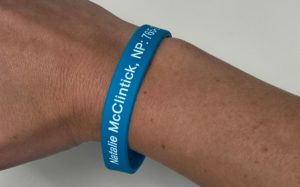
(Image above – bracelet patients receive with Natalie’s name and phone number)
What Outpatient Hip and Knee Replacement Patients Can Expect at CIO
- A dedicated Nurse Practitioner Patient Navigator who’s available 24/7
- Personalized preoperative education tailored to your goals and home environment
- Advanced surgical options, including Mako robotic-arm assisted technology
- Seamless communication between Natalie and your surgeon
- Options for home visits and virtual support
- A recovery plan designed for you — not one-size-fits-all care
JUMP TO: Hear Directly From CIO Mako Patients | Mako Frequently Asked Questions
The CIO Difference
In larger healthcare systems, communication can feel automated or delayed until your first follow‑up visit. At CIO, our outpatient hip and knee replacement model ensures you’re never navigating recovery alone. With advanced technology, coordinated care under one roof and a dedicated Nurse Practitioner Patient Navigator who works closely with your surgeon and is always available if you need support, you receive timely, human and highly coordinated care — the kind that brings peace of mind and keeps your recovery moving forward.
“Natalie McClinitick, Nurse Practitioner Patient Navigator” Video
Find Relief from Hip or Knee Pain
If hip or knee pain is limiting your life, don’t wait. Talk with a CIO joint replacement surgeon to explore whether conservative treatment or surgery is right for you.
To schedule an appointment, call 800-622-6575 or learn more at ciocenter.com/mako
Stories That Move Us | Real CIO Mako Patient Testimonials
Jim Garringer
Paul Gonzales
Kimberly Lyle-Ippolito
Beth Sperry
Steve Grove
Dr. Jamie Kay
Every patient is unique in their own recovery. Patient results can vary based on the patient’s health, the surgeon and technique used. Our surgeons discuss realistic recovery expectations with each patient prior to any surgery, as each patient is different.
Frequently Asked Questions
What is Mako SmartRobotics™?
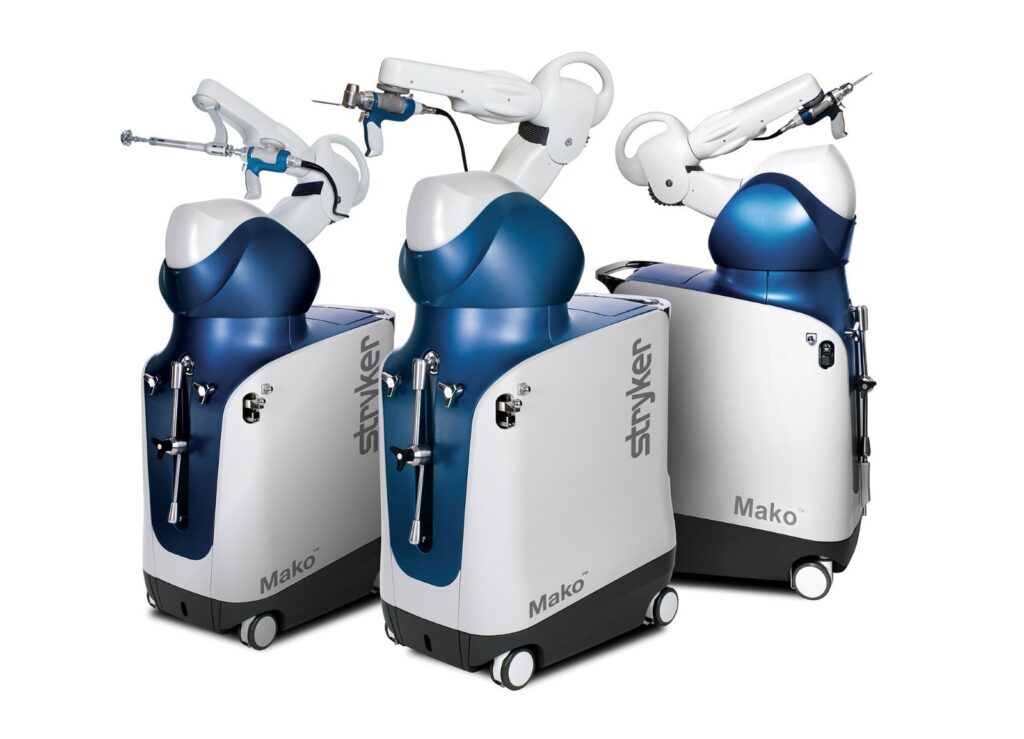
Mako SmartRobotics™ is an innovative surgical tool for many suffering from painful arthritis of the knee or hip and enables our patients to have a more predictable experience when undergoing joint replacement surgery. The technology combines 3D CT-based planning software with AccuStop haptic technology, so the surgeon can know more about the patient’s anatomy before and during surgery and only allows the surgeon to cut within pre-planned guidelines, preserving tissue and saving healthy bone.
What are the benefits of Mako joint replacement?
The main benefits include:
- Implants are placed in a perfect anatomic position for each patient, enabling better post-surgical movement and flexibility
- The surgeon is able to cut less, which causes fewer trauma and reduced risk of surgical complications
- With fewer trauma, the patient typically experiences less pain, uses less pain medication and in general recovers quicker
Does the robot actually perform the surgery?
No. The surgeon operates the robot while the robot guides the surgeon’s cuts. During surgery, the surgeon references a computer screen as a guide. The robot will not allow the surgeon to operate outside of the predetermined boundary.
What is the process of a Mako procedure?
First, we obtain a CT scan of the affected joint prior to surgery, which allows the surgeon to have an exact 3D replica of the affected joint. That CT data is loaded into the robot prior to surgery for the surgeon to plan the procedure. Once in surgery and the joint has been exposed, the surgeon uses a process called registration, which links the patient’s anatomy live to the CT scan loaded in the computer. It involves touching the bone around the joint in about 40-50 spots with a small device that the robot can see and registering those points.
The points on the bone that have been identified tell the robot more about the patient’s unique anatomy. The surgeon is able to see virtually where to make cuts, position components, etc., before actually starting the procedure. So, that’s what allows the surgeon to get the components in the perfect position, resulting in a safer procedure and minimal release of soft tissues.
What procedures can be performed with Mako technology?
Mako technology can be used for total hip and total/partial knee replacement procedures.
What conservative treatments are available to try before joint replacement surgery?
Conservative treatments to consider before surgery include oral anti-inflammatories, such as Tylenol, joint steroid injections and physical therapy.
Can the procedure be performed as outpatient?
Absolutely. We’ve been performing Mako hip and knee replacement as an outpatient procedure since our first robot was installed in 2016. Should our patients need a joint replacement in a hospital setting, we can perform those procedures at Ascension St. Vincent Anderson and Fishers Hospitals.
What can I expect during recovery from a Mako joint replacement?
Although every individual is unique and every treatment plan is different, general recovery times include in-hospital recovery for 1-4 days (unless it’s performed as outpatient), daily activities may be resumed 3-6 weeks following surgery and recovery to full activity is 6-12 months.
What activities can I participate in after joint replacement?
Generally, you can engage in activities you can tolerate with no restrictions after recovery. The goal is to help you return to the activities you love.
How long has Central Indiana Orthopedics been using Mako technology?
CIO was the first orthopedic practice in the region to utilize Mako technology with our first robot installed in our Muncie outpatient surgery center in 2016 and two additional robots installed in our Fishers outpatient surgery center in 2019 and 2024. As the orthopedic surgeons of Ascension St. Vincent Anderson and Fishers hospitals, our surgeons use the robots they purchased in 2020 (Fishers) and 2021 (Anderson).
What surgeons at Central Indiana Orthopedics are certified to perform Mako procedures?
The following board-certified orthopedic surgeons are certified in Mako technology
- Brian Camilleri, DO (Mako Knee Replacement, Traditional Knee Replacement)
- Ryan Cieply, MD (Mako Hip & Knee Replacement, Traditional Hip & Knee Replacement)
- Brent Damer, DO (Mako Hip & Knee Replacement, Traditional Hip & Knee Replacement)
- Ryan Jaggers, MD (Mako Hip & Knee Replacement, Traditional Hip & Knee Replacement)
- Joseph Jerman, MD (Mako Hip & Knee Replacement, Traditional Hip & Knee Replacement)
- P. Jamieson Kay, MD (Mako Knee Replacement, Traditional Hip & Knee Replacement)
- John R. Martin, MD (Mako Hip & Knee Replacement, Traditional Hip & Knee Replacement)
- Nimu Surtani, MD (Mako Knee Replacement, Traditional Knee Replacement)
Mako-assisted hip or knee replacement surgery can be performed at Central Indiana Orthopedics Muncie Surgery Center, Central Indiana Orthopedics Fishers Surgery Center, Ascension St. Vincent Fishers Hospital or Ascension St. Vincent Anderson Hospital.
What training is required for a surgeon to become certified in Mako technology?
Every surgeon who wants to operate using Mako technology must complete additional training, which typically includes hands-on training in a lab operating on cadavers and completing classwork. Most importantly, a surgeon who is certified in Mako technology is already a trained joint replacement surgeon and performs numerous traditional joint replacements per year.
How do the risks compare between a Mako joint replacement and a traditional joint replacement?
Essentially, the risk profile is the same between a Mako robotic procedure and traditional joint replacement procedure.
What is considered a successful result?
With any joint replacement, we would consider a successful result to be a happy patient. Our goal is for the patient to return to the activities they loved doing prior to when the joint became arthritic and painful.
Is there an additional charge to insurance for Mako procedure?
Patients will not see any additional charge for the Mako procedure, as it is charged the same as a traditional joint replacement.
How will I know I’m ready for surgery?
At CIO, we tell our patients: when you’re ready to get your joint replaced, you’ll know. You’ll be miserable enough that you just can’t stand it. You’ll find yourself avoiding things you really like to do, such as walking significant distances, stair climbing, trouble with sleep, stopping hobbies. We understand that surgery can be a difficult decision, so we let the patient make that decision, which typically comes after conservative treatment has already been tried. Our goal with any surgery is to get the patient back to what they loved doing before the joint became arthritic and painful.
How can I learn more or schedule an appointment?
If you are interested in learning more about Mako technology, visit ciocenter.com/mako. To schedule an appointment, call 800-622-6575 or request an appointment online.